
Kuari Pass Trek

Region
Uttarakhand

Duration
5 days

Max. Altitude
12600 ft

Trek Distance
30 kms

Grade
Moderate
Fixed Departures
November -2026
- 2 Nov - 7 Nov
- Open
- 8 Nov - 13 Nov
- Open
- 14 Nov - 19 Nov
- Open
- 21 Nov - 26 Nov
- Open
December - 2026
- 1 Dec - 6 Dec
- Open
- 7 Dec - 12 Dec
- Open
- 13 Dec - 18 Dec
- Open
- 19 Dec - 24 Dec
- Open
- 25 Dec - 30 Dec
- Open
January - 2027
- 1 Jan - 6 Jan
- Open
- 7 Jan - 12 Jan
- Open
- 13 Jan - 18 Jan
- Open
- 19 Jan - 24 Jan
- Open
- 25 Jan - 30 Jan
- Open
February - 2027
- 1 Feb - 6 Feb
- Open
- 7 Feb - 12 Feb
- Open
- 13 Feb - 18 Feb
- Open
- 20 Feb - 25 Feb
- Open
₹9,000
+5% GST / Person
Highlights
- Services from: Joshimath to Joshimath
- Pickup & Drop Location (if transport opted) : Back Stayz, Laxman Jhula Tapovan, Rishikesh
- Pickup : 6:00 AM | Drop : 6:30–7:30 PM (weather/road dependent) Keep a buffer day and arrive a day early to avoid delays.
Add-ons
- Transport
- Rs 2000/- Per Person
- Offload
- Rs 1500/- Per Person
Add on information
- Insurance is mandatory.
- It is available for Indian citizens only.
- Non-Indians have to take insurance on their own.
- The cancellation policy will be implemented in accordance with the trek cancellation policy.
- Transportation: Rishikesh to Joshimath & return is optional.
- Choose add-ons during booking. If missed, you can contact us to book the same.
- Book transportation at least 10 days before the trek.
- Cancellation 6 or more days before the start of the trip results in a 100% cash refund.
- Cancellation less than 4 days from the start of the trip results in a 50% cash refund.
- Cancellations made on the trip date are not eligible for a refund.
- Backpack offload is optional.
- Choose add-ons during booking. If missed, you can contact us to book the same.
- Book off-load at least 10 days before the trek.
- For offline bookings at the base camp, a variable convenience fee may apply. (It differs from trek to trek)
- Offload can't weigh more than 10kg. Offload should have a waterproof cover. Suitcases/trolleys will not be allowed.
- In the event that you choose to cancel your trek prior to the departure date, you will receive a full refund.
- Note : The bag weight should not exceed 10 kg.
Kuari Pass Trek Overview
- Trek Name : Kuari Pass Trek
- Days : 5
- Adventure : Trekking
- Base Camp : Joshimath
- Season : Spring | Summer | Autumn | Winter
- Months : January | February | March | April | May | June | September | October | November | December
- Country : India
- Altitude : 12600 ft
- Grade : Moderate
- Trail Type : Circle trail | Camping in various locations, starting and ending at the same point.
- Food : Meals while on trek & at Hotel/Guesthouse (Veg & Eggs)
- Location : Uttarakhand
- Distance : 27 km
- Rail Head : Haridwar/Rishikesh is the nearest rail head to the base camp
- Stay : Camping (Twin sharing) & Hotel/Guesthouse (Separate for male & Female)
- Airport: Jolly Grant Airport, which is 21 km away from Rishikesh
Why is Kuari Pass a Must-Do Trek ?
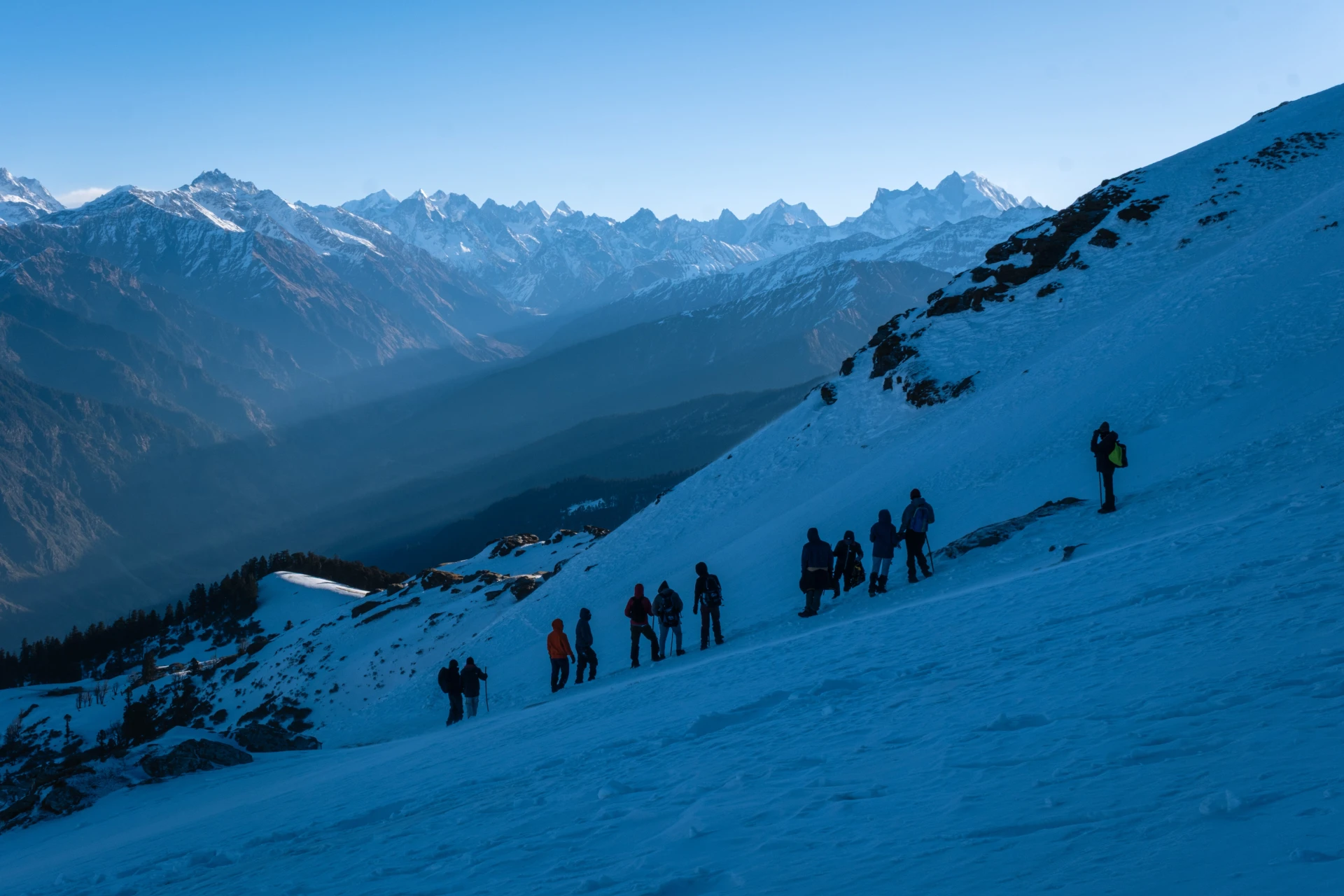
- Trek Through Pristine Snowfields : Trek through vast, snow-covered meadows during winter and immerse yourself in a winter paradise that feels like a true wonderland.
- The Curzon Trail : Follow the historic route pioneered by Lord Curzon, adding a touch of legacy and adventure to the trek as you walk in the footsteps of explorers past.
- 280° panoramic Himalayan Views : From Kuari Pass, witness unparalleled 280-degree panoramic views of famous Himalayan peaks, including Kamet, Chaukhambha, Dronagiri, Changabang, Kunti bhandar, and Neelkanth and many more, providing an unforgettable mountain panorama.
- Nanda Devi Sanctuary : A UNESCO World Heritage Site known for its rich biodiversity, wilderness and you will trek through it.
- Charming Himalayan Villages : Trek through remote Garhwal villages like Tugasi and upper Tugasi, where you can immerse yourself in the culture and lifestyle of the mountain people.
- Tali Lake : A serene high-altitude lake often frozen in winter, reflecting the surrounding snow-covered peaks especially Nanda Devi and Dronagiri.
- Stargazing at Trek : Set up under crystal-clear skies, the Pipalkoti campsite provides some of the best stargazing opportunities, with stars twinkling bright above towering mountains.
- Auli's Beauty : The trek's proximity to Auli, known for its stunning views and ski slopes, makes it an added bonus for trekkers to explore before or after the trek.
Major Attractions of the Kuari Pass Trek:
- Talli Forest : Moving forward, you enter the Talli Forest, a magical place where every step feels like wandering into a kingdom of snow. Towering pine and oak trees rise around you, their trunks dusted with snow, while sunlight occasionally filters through the dense canopy, casting patterns on the ground. The quiet here is profound, broken only by the sounds of your footsteps and the occasional chirp of a hidden bird. It's a place that invites you to pause, take a deep breath, and truly feel the peace of the wilderness.
- Kuari Pass : You will climb higher, and the trail opens up to Kuari Pass, a vantage point that feels like the roof of the world. From here, the vast expanse of the Himalayas unfolds in all directions, with the peaks standing tall. It’s a perfect spot to rest, and marvel at the majesty that surrounds you, a view that makes every step of the climb worthwhile.
- Kuari Pass, marking a period in the history of trek and travel known as the Golden Age of Trekking throughout the Himalayas and beyond. The honour of being the first European to explore and report the route has led to its continued growth, but it ranks ahead of all other trails in prestige.
Eligiblity for Kuari Pass Trek
- Age Requirement : April to November: 10 years, December to March: 12 years.
- First-timers are welcome, though prior trekking experience is preferred. Good fitness is a must.
- Fitness Criteria :
- The Trekker should have sufficient stamina to cover 5 km of distance by jogging in 33 minutes without stress or 10 km of distance in 75 minutes without stress
- If the trekker prefers cycling he/she should be able to cycle 15 km of distance in 45 minutes .
- If the trekker wants to carry a backpack then he/she should be able to carry a 10-12 kg backpack. If opt Off-load option then the trekker should be able to carry 3-5 kg backpack.
- If a trekker's BMI is more or less than the normal range (18-28), please consult our Trek Coordinator before booking.
Kuari Pass Trek Itinerary
01. Drive from Rishikesh to Joshimath
- Altitude: 1,875 m/6,151 ft
- Drive Distance: 250 km | 10-11 hours.
02. Joshimath to Tali forest via Dhak
- Altitude:
- Dhak village: 2,800 m/ 9,186 ft.
- Tali forest: 3,297 m/ 10,820 ft.
- Drive Distance Joshimath to Dhak village: 10 km | 1hrs.
- Trek Distance: 5 km | 2-3 hrs.
03. Tali Forest Camp to Khullara
- Altitude: 3,350 m/ 11,080 ft
- Trek Distance: 5 km | 4-5 hours.
04. Khullara camp to Kuari Pass and return
- Altitude:
- Kuari Pass: 3,840 m/ 12,600 ft.
- Trek Distance: 10-11 km | 8-9 hours.
05. Khullara to Dhak and drive to Rishikesh
- Altitude:
- Dhak village: 2,800 m / 9,186 ft
- Trek Distance: 9 km | 4-5 hours.
- Drive Distance: 250 km | 10-11 hrs
- Note : If weather and snow conditions allow, we will return via Auli or retrace the same route.
Rishikesh to Joshimath
- Altitude : 1,875 m/ 6,151 ft
- Drive Distance : 250 km | 9-10 hours
Your journey begins in Rishikesh, a city known for its spiritual aura and adventure activities. Trekkers will be picked up from Rishikesh. For those who wish to explore more, Rishikesh itself is a hub for cultural experiences and adrenaline-pumping water sports. You might want to extend your stay for a day or two to indulge in activities like river rafting or visiting sacred sites like the Triveni Ghat, known for its enchanting evening aarti.
The road trip starts along the pleasing Badrinath Road. The journey is long, but filled with captivating landscapes and cultural landmarks, making the 9-10 hour drive to Pipalkoti an enriching experience. You will also notice how the Alaknanda River character transforms, starting as a serene flow but becoming increasingly wild and powerful as we climb higher into the Himalayas. The sights are truly spellbinding, with the river carving through the valley and towering peaks lining the horizon.
You will also pass by the four Prayags, holy confluences of the Ganga’s tributaries. These include Devaprayag, where the Alaknanda meets the Bhagirathi to form the Ganga; Rudraprayag, where the Mandakini joins; Karnaprayag, where the Pindar River merges; Nandaprayag with the Nandakini. All these four sacred confluences that are not only picturesque but also hold deep spiritual significance in Hindu mythology.
While the journey may be long, the constantly changing views of rivers, mountains, and valleys will keep you engaged. Be ready to capture these scenic moments, as they are some of the most beautiful sights you’ll see before reaching your destination
Joshimath to Tali forest via Dhak
- Altitude :
- Dhak village: 2800 m/ 9,186 ft.
- Drive Distance (Joshimath to Dhak) : 10 km | 1 hrs.
- Trek Distance : 5 km | 2-3 hrs.
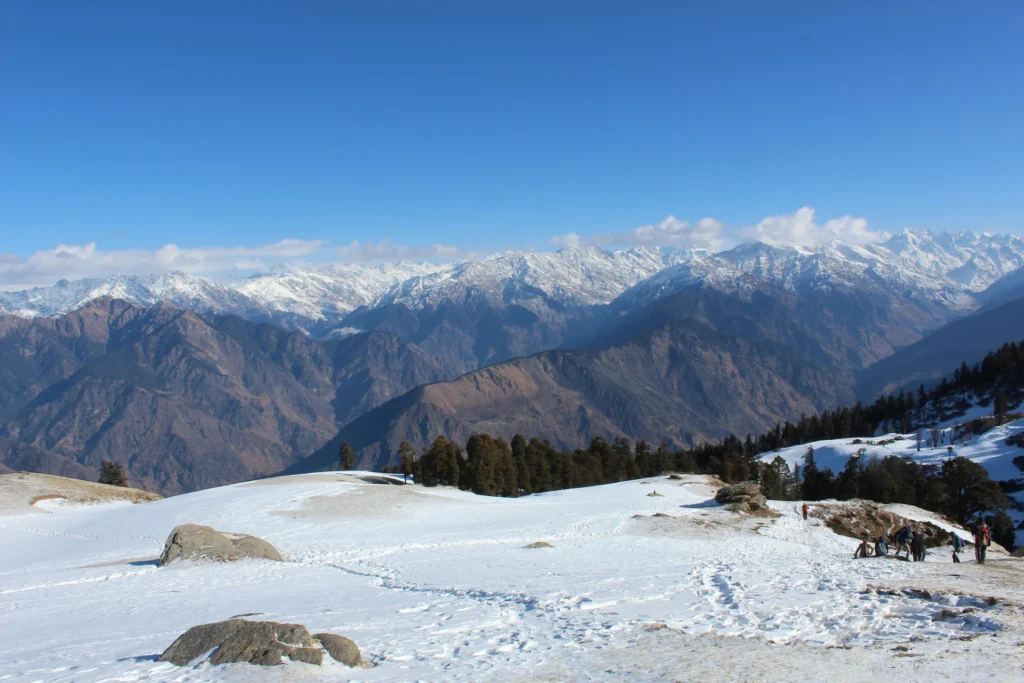
After breakfast, drive to Dhak village, the starting point of the trek. The trail gradually ascends through beautiful oak, rhododendron, and pine forests. The peaceful forest trail provides excellent opportunities to observe Himalayan flora and birdlife. By afternoon, you will reach Tali Forest Camp, surrounded by dense woodland and mountain scenery.
The initial part of the trek takes you through agricultural lands with terraced farms, a typical feature of the region. While greenery may not be abundant, the panoramic views of the Garhwal frontier more than compensate. As you climb, look out for the Dhauli-Ganga River glistening far below and the Vishnugad-Tapovan Hydroelectric Power Station in the distance.
The ascent becomes steeper as you leave behind the terraced farms and move higher up the trail. Soon, you’ll encounter the stunning sight of Dronagiri peak, which appears hauntingly beautiful in the distance, creating an almost magical feeling.
Tali Forest Camp to Khullara camp
- Altitude : 3,350 m/ 11,080 ft
- Trek Distance : 5 km | 4-5 hours
- Accommodation : Tent
- Peaks Spotted : Nanda Devi, Kalanka, Chang Bang, Dronagiri, Hathi Parvat, Gauri Parbat
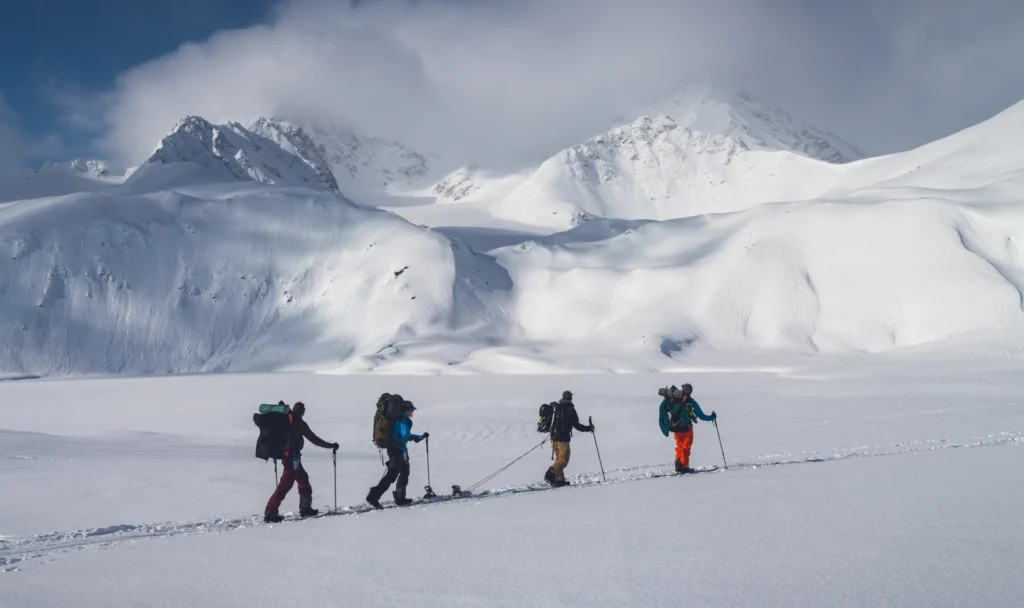
Waking up to the pleasing views of Dronagiri Peak, you’ll prepare for a day of trekking deeper into the serene forests of Tali. This 5-hour trek will be more relaxed compared to the previous day, providing you to enjoy the journey at a leisurely pace. The trail gradually ascends with gentle gradients, making it an easier but equally scenic hike.
About 20 minutes into the trek, you’ll reach a beautiful green clearing. From here, you can take in stunning panoramic views of the mighty snow-clad peaks, including Nanda Devi, Kalanka, Chang Bang, and Hathi Parvat, Gauri Parvat. After soaking in the views, you’ll continue trekking through a stream, which marks the entrance to the dense forests.
The trek leads you into a mixed forest thick with oak, rhododendron, and walnut trees. If you’re trekking in late March or early April, you may catch the pink and white rhododendron blossoms, adding a splash of colour to the forest. In winter, the forest transforms into a snow-covered wonderland, where the interplay of light and shadow through the towering conifers creates a magical atmosphere.
As you trek further, you’ll get glimpses of the Hathi and Gauri Parbat peaks, their snow-covered front glistening in the sun. Dronagiri, which had been a constant companion on the trail, now appears from a different angle, revealing new facets of its majestic beauty.
Khullara camp to Kuari pass and return
- Altitude :
- Kuari Pass: 3,840 m/ 12,600 ft
- Trek Distance : 10-11 km | 8-9 hours
- Accommodation : Tent
Peaks Spotted: Chaukhamba, Balakun, Neel Kantha, Mukut Parvat, Kamet, Abhi Gamin, Mana I, Gauri Parbat, Hathi Parvat, Dronagiri, Kalanka, Chang Bang, Nanda Devi, Nanda Ghunti, Pangarchulla Peak
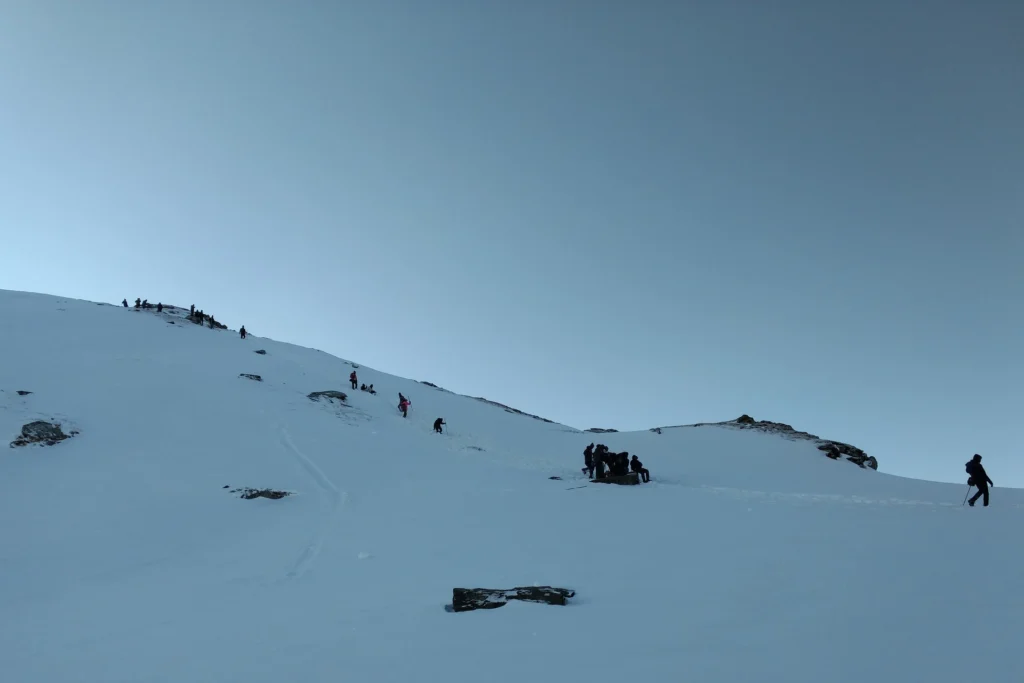
This is the summit day of the Kuari Pass trek and the toughest challenge of the journey. Prepare for a long, strenuous 8-9 hour trek that will take you through some of the most breathtaking terrain and panoramic views the Garhwal region has to offer. You’ll need to carry sufficient water today, as there are no water sources along the route.
After another 1km, you’ll arrive at Khullara Top, where a vast, open landscape unveils an array of towering peaks. It’s the perfect spot to pause and soak in the awe-inspiring scenery. Lunch is typically carried along and can be enjoyed either en route.
After trekking 2 kilometers from Tali Forest, you’ll reach Jhandi Top. A perfect spot for a well-deserved rest. Known for its stunning surroundings and panoramic views.
The next section involves a traverse walk to a frozen stream near a broken bridge at 3,750m. This 1.5 km section is challenging but offers stunning scenery. From here, the real test begins, a strenuous 1 km climb to Kuari Pass itself. The Kedarnath Peak, Chaukhamba, Neelkantha, and Nanda Devi are among the many towering summits that will surround you.
Khullara to Dhak and drive to Rishikesh
- Altitude :
- Khullara camp: 3,550 m/ 11,080 ft
- Trek Distance : 9 km | 4-5 hours
- Drive Distance : 250 km | 10-11 hrs
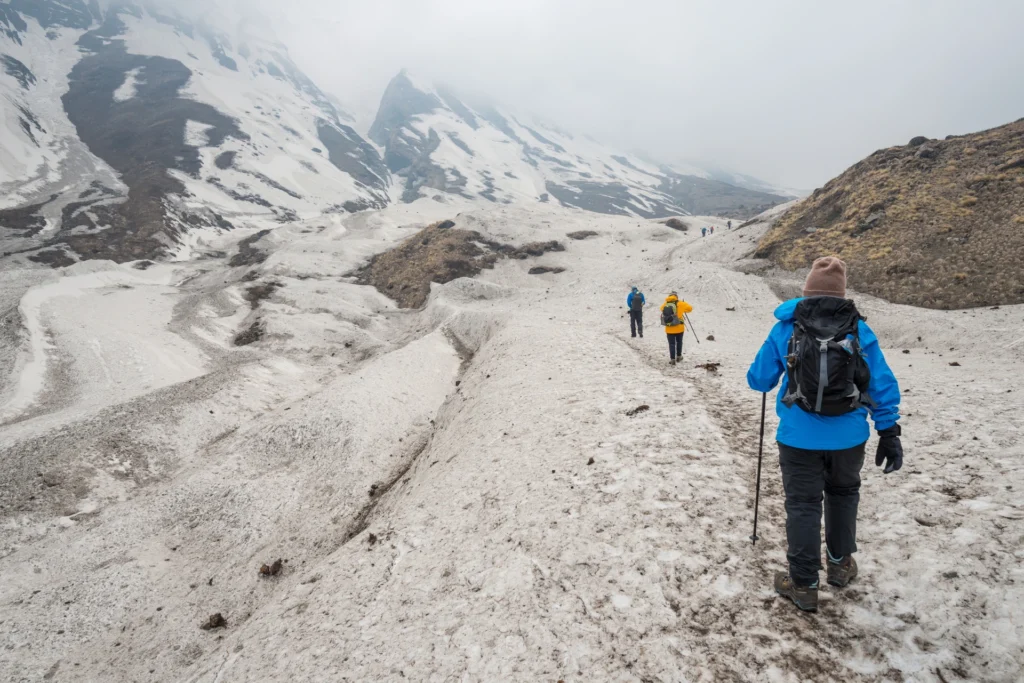
You’ll embark on the last stretch of your trek, which takes you through some of the most scenic landscapes of the journey.
After breakfast, begin the descent through forests and mountain trails back to Dhak village. From Dhak, drive to Rishikesh while enjoying the final views of the Garhwal Himalayas and the Alaknanda valley. By evening, you will reach Rishikesh with unforgettable memories of one of Uttarakhand’s most scenic treks.
Health Awareness
- Pulse rate at rest must be in between (60 to 100 beats per minute).
- Blood Pressure Reading must be in between (DIASTOLIC 75 – 85, SYSTOLIC 100 - 130 mm Hg).
- Respiratory rate at rest must be in between (12 to 20 breaths per minute).
- Should not have Liver and kidney issues.
- Should not have Diabetes Mellitus, Bronchial Asthma, Heart problems, Hypertension, etc.
- No pacemaker implant.
- People with Sinus issues, Epilepsy please contact to trek coordinator before booking the trek.
- If your BMI is not normal, Please contact our Trek coordinator before Trek booking.
Important Links
How to Reach:
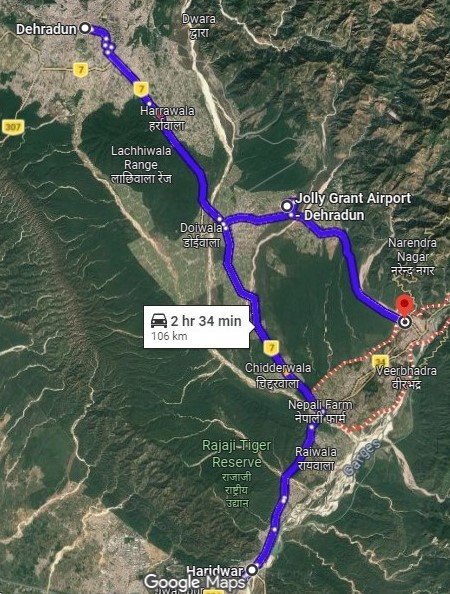

Pick-Up Information
- It is essential for everyone to arrive at Rishikesh (06:00 am)
- Pick-up Location - Back Stayz Laxman Jhula Near SBI Bank Tapovan Once you have reached Rishikesh, WTM will manage the rest of your travel arrangements, if you have opted for WTM's pick-up service, you can select this option during the booking process by adding it as an add-on.
Options to Reach Rishikesh
First, you can arrive at Delhi, Dehradun airport or Chandigarh. The journey from these locations to Rishikesh is explained below.
- 1. Take overnight train/bus to Rishikesh.
- 2. Take overnight train/bus to Haridwar and drive to Rishikesh (25km | 35 min drive with normal traffic).
- 3. Take overnight train/bus to Dehradun and drive to Rishikesh (50km | 1hr 20min drive with normal traffic).
- ( We strongly recommend going for the govt. Buses over the private ones outside the bus station as based on the experience we have found that there are very high chances of delay involved with private buses. Also, govt. Buses are always more reliable. Whichever bus you choose, just make sure to reach Rishikesh at least by 05:30 am. )
- 4. Board a flight to Dehradun airport (Jolly Grant Airport) (21 km, 30 min). If you're arriving by air, then come one day in advance.
Drop-Off Information
- The designated drop-off point is Tapovan, Rishikesh.
- Reach in Rishikesh by 6:30 to 7:30 pm.
- Please consider planning your subsequent travel arrangements after 10:00 pm.
- Note - In July and August month always have a buffer day in your Itinerary due to the Monsoon.
- It's highly advisable to keep a buffer day in your travel plan. If the buffer day is not used, it can be used to explore Rishikesh.
- ( If you prefer to travel independently to Base camp and don't want to take WTM's pick-up service, you can either take a government bus or book a private cab from Rishikesh.
- WTM offers comfortable transportation through Tempo Traveler, Bolero, or equivalent vehicles. If you wish to upgrade your mode of transportation, please contact your trek coordinator for further assistance.
Cost Terms
1. Accommodation (as per the itinerary)
- Camping while on trek, twin sharing. (Males and females are accommodated separately.
2. Meals (Veg + Egg)
- All meals (including tea, soup, snacks, etc.) from Day 1 Dinner to Day 5 Dinner.
3. Support
- 1 Versatile base camp manager handles communication and deploys extra manpower in emergencies.
- 1 Mountaineering & First aid qualified professional trek Leader.
- 1 Experienced high-altitude chef.
- Local experienced guides (Number of guides depending on the group size).
- Enough support staff.
4. Trek Equipment
- Sleeping bag, Sleeping liners (if required), mattresses, and Utensils.
- 3 men all season trekker tent (twin sharing), Kitchen & Dining tent, Toilet tent.
- Camping stool, Walkie talkie.
- Ropes, Helmet, Ice axe, Harness, Gaiters & microspikes (if required).
5. First Aid
- Medical kit, Stretcher, Oxygen cylinder, Blood pressure monitor, Oximeter, Stethoscope.
6. Mules/porters to carry the central luggage.
7. All necessary permits and entry fees, up to the amount charged for Indians.
8. Trek Completion Certificate.
- Insurance (For non-Indian Nationals, NRI or OCI card holders).
- Transportation: From: Rishikesh to Joshimath & return
- Food during the transit.
- Any kind of personal expenses.
- Mule or porter to carry personal luggage.
- Emergency evacuation, hospitalization charge, etc.
- Any extra costs incurred due to extension/change of the itinerary due to natural calamities roadblocks, vehicle breakdown, etc. factors beyond our control
- Anything not specifically mentioned under the head Inclusion.
Trek Essentials
| Backpack with rain cover | (40 – 50 ltr) with comfortable shoulder straps |
| Day pack with rain cover | 20 – 30 ltr (If off-load opted) |
| Walking stick | Advisable (At least one) |
| Water Bottle / Hydration pack | 2 bottles of one liter each, People who use hydration pack 1 hydration pack and 1 bottle of one liter, Carry at least one thermos flask. |
| Small size tiffin/lunch box | 1 Nos |
| Snacks | Energy bars, dry fruits, electral/ors |
| Personal Medical Kit | Consult your doctor |
| T-Shirt (Synthetic quick dry) | 1 Full & 1 Half sleeves |
| Fleece T-shirt | 1 Nos |
| Fleece jacket | Not required |
| Windproof Jacket | 1 Nos |
| Down feather / Hollow jacket | 1 Nos |
| Thermal inner (Upper and Lower) | 1 Pair |
| Trek Pant (Synthetic quick dry) | 1 Nos |
| Fleece Pant | Not required |
| Waterproof gloves | Not required |
| Fleece / woollen gloves | 1 Pair |
| Poncho / waterproof Jacket and pant | 1 Nos |
| Head torch | 1 Nos. (Avoid Hand torch) |
| Sun cap | 1 Nos. (One that covers the neck as well) |
| Woolen cap | 1 Nos. |
| Balaclava | Not required |
| Buff / Neck-gaiters | 1 Nos. |
| Sunglasses | UV with dark side cover, People who wear spectacles – (A)- Use contact lenses | (B)- Photo chromatic glasses |
| Trekking shoes | 1 Pair (Water-resistant, high ankle with good grip) |
| Floaters / flip-flops | 1 Pair |
| Cotton socks | 6 pairs |
| Woollen socks | 1 pairs |
| Gaiters | 1 Pair (WTM provides when required) |
| Micro spikes | 1 Pair (WTM provides when required) |
| Sunscreen cream | 1 Nos |
| Moisturiser | 1 Nos |
| Chap-stick / Lip balm | 1 Nos |
| Toothbrush and toothpaste | 1 Nos |
| Toilet paper & Wipes | 1 Nos |
| Soap / hand sanitizers | 1 Nos |
| Antibacterial powder | 1 Nos |
| Quick dry towel | 1 Nos |
Gallery
Cancellation Terms
To request a cancellation, please email us at info@walkingthemountains.com using your registered email ID.
Cancellations prior to 28 days from the start of the Trip
Refund Options
- 5% deduction of trek fee
- 100% trek fee cash voucher for any trip until six months from the date of last trek.
- Transfer your trek (any trek, any date) to your friend
Cancellation between 27 days and 15 days to the start of the Trip
Refund Options
- 30% deduction of trek fee
- 100% trek fee cash voucher for same trip till one year
- 85% trek fee cash voucher for any trip till one year
Cancellation between 14 days and 8 days to the start of the Trip
Refund Options
- 50% deduction of trek fee
- 80% trek fee cash voucher for same trip till six months.
- Book the same trek, in the same season, with any other batch
- Transfer your trek (same trek, any date) to your friend
Cancellation less than 7 days to the start of the trek.
Refund Options
- No cash refund
- 20% trek fee cash voucher for the same trip until six months.
Itinerary and Modifications
- WTM reserves the right to modify, shorten, or cancel any part of the Trip due to transportation delays, weather, health emergencies, or other unforeseen circumstances including Force Majeure.
Cancellations and Refunds
- No refunds or vouchers, partial or otherwise, shall be provided for voluntary withdrawal, non-utilisation of services, or removal from the Trip.
- If WTM cancels the Trip before arrival at the designated pick-up point due to unforeseen circumstances or Force Majeure, the Participant may choose from:
- An alternate Trip/date.
- A credit voucher valid for one (1) year.
- Transfer to another Trip, with cost differences payable by the Participant.
- If the Trip is abandoned post-arrival at the designated pick-up point, no cash refund or voucher shall be issued. The Trek Again Policy may apply at WTM’s discretion.
- WTM shall not be liable for any associated travel costs such as flights, accommodation, or visa fees.
Force Majeure
- Events beyond its control including but not limited to earthquakes, landslides, strikes, curfews, war, pandemic, government restrictions, heavy rainfall or snowfall, windstorms, road blockages, trail disruption, or withdrawal of permits, WTM shall not be held liable for any cancellation, delay, or service modification caused by Force Majeure.
FAQ’S
The best time to trek is October to March for Narnia snow experience and spring offers blooming rhododendrons.
The maximum altitude reached during the Kuari Pass Trek is 12,750 ft.
Yes, it is safe to do the Kuari Pass Trek with an expert organization. However, it is always advisable to take necessary precautions and follow safety guidelines issued by the Trek Leaders and guide while trekking in the mountains.
On the Kuari Pass Trek, you will be camping in different campsites. We provide twin-sharing tents for optimum comfort.
Here are some of the essential items that you should bring for the trek:
- Mountaineering Boots:Sturdy, waterproof boots with good ankle support and crampon compatibility are a must.
- Warm Clothing:This includes a warm-down jacket, thermal inner layers, and waterproof outer layers.
- Backpack:A durable backpack to carry your equipment and personal items.
- Sunglasses:To protect your eyes from harmful UV rays and snow glare.
- Gloves:Waterproof and warm gloves that provide dexterity and grip.
- Headlamp:A powerful headlamp with extra batteries for se during early morning starts or late night hikes.