
Valley of Flowers Trek

Region
Uttarakhand

Duration
6 days

Max. Altitude
14100 ft

Trek Distance
37 kms

Grade
Easy to Moderate
No Batches Available
August - 2026
- 26 Aug - 31 Aug
- closed
September - 2026
- 14 Sept - 19 Sept
- closed
₹10,000
+5% GST / Person
Highlights
- Services from Pipalkoti to Pipalkoti
- Pickup & Drop Location (if transport opted ) : Back stayz (hotel) Laxman Jhula Near SBI Bank Tapovan, Rishikesh
- Pickup : 6:00 AM | Drop : 6:30–7:30 PM (weather/road dependent) Keep a buffer day and arrive a day early to avoid delays.
Add-ons
- Transport
- Rs 3000/- Per Person
- Offload
- Rs 800/- Per Person
Add on information
- Insurance is mandatory.
- It is available for Indian citizens only.
- Non-Indians have to take insurance on their own.
- The cancellation policy will be implemented in accordance with the trek cancellation policy.
- Transportation: Rishikesh to Pipalkoti is ₹2,200 per person.
- If you are arriving in your own vehicle at Pipalkoti, you only need to pay ₹1000 for the Govindghat to Pulna(to & fro) and Badrinath visit.
- Choose add-ons during booking. If missed, you can contact us to book the same.
- Book transportation at least 10 days before the trek.
- Cancellation 6 or more days before the start of the trip results in a 100% cash refund.
- Cancellation less than 4 days from the start of the trip results in a 50% cash refund.
- Cancellations made on the trip date are not eligible for a refund.
- Backpack offload is optional.
- Choose add-ons during booking. If missed, you can contact us to book the same.
- Book off-load at least 10 days before the trek.
- For offline bookings at the base camp, a variable convenience fee may apply. (It differs from trek to trek)
- Offload can't weigh more than 10kg. Offload should have a waterproof cover. Suitcases/trolleys will not be allowed.
- In the event that you choose to cancel your trek prior to the departure date, you will receive a full refund.
- Note : The bag weight should not exceed 10 kg.
Valley of Flowers Trek Overview
- Trek Name : Valley of Flowers Trek
- Days : 6
- Adventure : Trekking
- Base Camp : Pipalkoti
- Season : Monsoon
- Months : July | August | September
- Country : India
- Altitude : 14100 ft
- Grade : Easy to Moderate
- Trail Type : Point to point trail | Camping at the same location upon returning.
- Food : Meals while on trek & at Hotel/Guesthouse (Veg)
- Location : Uttarakhand
- Distance : 37 km
- Rail Head : Haridwar/Rishikesh is the nearest rail head to the base camp
- Stay : Triple or Dormitory basis only(Separate for male & Female)
- Airport: Jolly Grant Airport, which is 21 km away from Rishikesh
Why is the Valley of Flowers a Must-Do Trek?
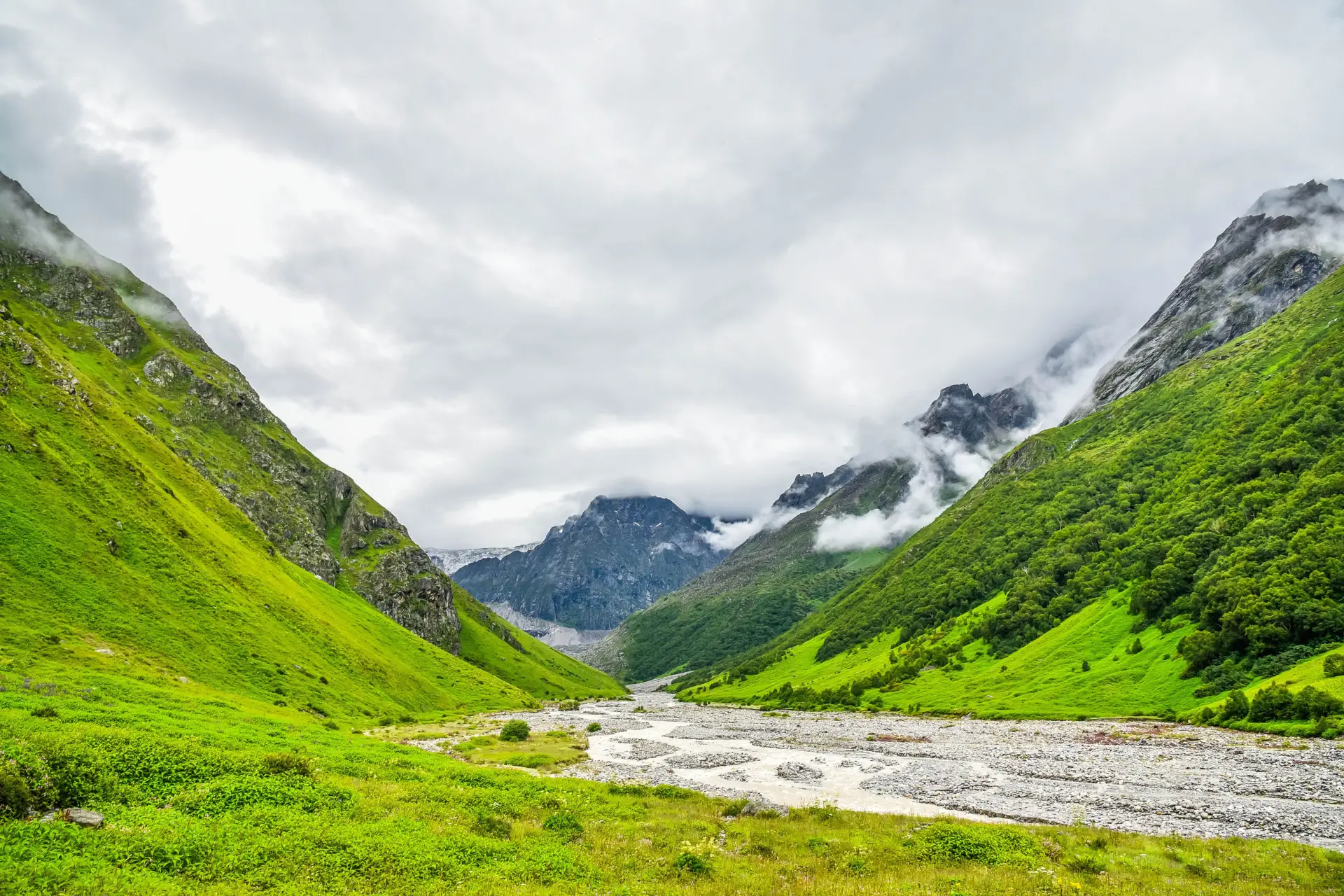
- As the name suggests, the highlight of the trek is a stunning valley adorned with vibrant flowers that stretch endlessly across the landscape.
- The trek is renowned for its blooming alpine flora, with over 500 species of rare and colourful flowers.
- One of the key highlights of the journey is a visit to Hemkund Sahib, one of the highest gurudwaras in the world. It is not only a sacred site but also a stunningly scenic location.
- The Valley of Flowers is recognized as a UNESCO World Heritage Site, celebrated for its exceptional natural beauty and surreal environment.
- On the way, you pass through Pulna with small local shops and flowing rivers along the trail before reaching Ghangaria, the base camp for both the Valley of Flowers and Hemkund Sahib treks.
A Unique Botanical Paradise In The Himalayas
UNESCO World Heritage site is in an elevational transition zone between the rugged peaks of the Zanskar Range and the Great Himalayas, making this high-altitude sanctuary an incredible botanical treasure for wildlife enthusiasts. The rare flora includes over 500 species of wildflowers, including many endemic species with medicinal properties such as the Blue Poppy and the Brahma Kamal. Wandering through a globally significant microclimate, trekkers will trek through an area with a plethora of plant life not found anywhere else on Earth; all this beauty is framed by the striking contrast of the snow-capped granite peaks and the jagged edges of the surrounding mountains.
Some historical Facts :
The history of the trek began with that accidental discovery in 1931 by Frank S. Smythe and his fellow climber Eric Shipton. They had lost their path in heavy monsoon fog after climbing Mount Kamet and unexpectedly walked down into this hidden paradise. Fascinated by the experience, Smythe returned in 1937 to live in the valley for several weeks to study the plants and later published a highly popular book titled The Valley of Flowers. This book introduced the remote Himalayan trail to adventurers worldwide.
In 1939, a British botanist named Joan Margaret Legge traveled there to study the flowers but tragically lost her life after slipping on a steep rocky slope; her memorial grave still stands on the trekking trail today. To protect its rich history and biodiversity, the Indian government made it a National Park in 1982, and it later became a globally recognized UNESCO World Heritage Site
The history of the trek began with that accidental discovery in 1931 by Frank S. Smythe and his fellow climber Eric Shipton. They had lost their path in heavy monsoon fog after climbing Mount Kamet and unexpectedly walked down into this hidden paradise. Fascinated by the experience, Smythe returned in 1937 to live in the valley for several weeks to study the plants and later published a highly popular book titled The Valley of Flowers. This book introduced the remote Himalayan trail to adventurers worldwide.
Eligiblity for Valley of Flowers Trek
- Age Requirement : Minimum 9 years
- First-timers are welcome, though prior trekking experience is preferred. Good fitness is a must.
- Fitness Criteria :
- The Trekker should have sufficient stamina to cover 5 km of distance by jogging in 45 minutes without stress.
- If the trekker prefers cycling he/ she should be able to cycle 10 km of distance in 30 minutes.
- If the trekker wants to carry a backpack then he/she should be able to carry a 10-12 kg backpack. If opt Off-load option then the trekker should be able to carry a 3-5 kg backpack.
- If a trekker's BMI is more or less than the normal range (18-29), please consult our Trek Coordinator before booking.
Valley of Flowers Trek Itinerary
01. Rishikesh to Pipalkoti
- Altitude:
- Rishikesh: 372 m / 1,220 ft.
- Pipalkoti: 1,340 m / 4,400 ft.
- Altitude Gain: 968 m / 3,180 ft.
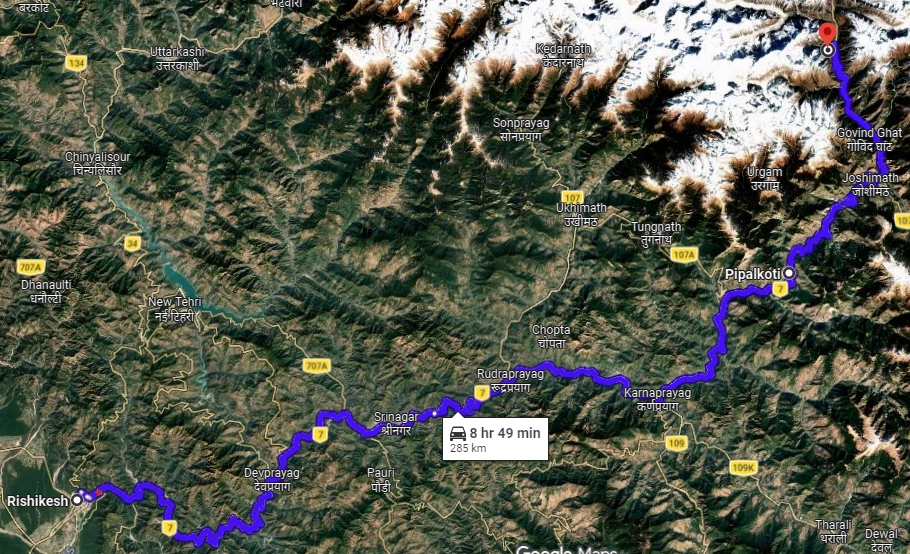
- Drive Distance: 200 km
- Driving Time: 9-10 hrs
02. Drive From Pipalkoti to Govindghat-Pulna and Trek to Ghangaria
- Altitude:
- Pipalkoti: 1,340 m / 4,400 ft.
- Govindghat: 1,828 m / 6,000 ft.
- Pulna: 2,100 m / 6,900 ft.
- Ghangharia: 3,000 m / 9,800 ft.
- Altitude Gain: 1,660 m / 5,400 ft.
- Drive Distance (Pipalkoti to Govindghat): 52 km | 2 hrs.
- Drive Distance (Govindghat to Pulna): 4 km | 15–20 min.
- Trek Distance (Pulna to Ghangharia): 9 km | 3–4 hrs.
03. Ghangaria to Valley of Flower and back to Ghangaria
- Altitude:
- Ghangharia: 3,000 m / 9,800 ft.
- Valley of Flowers: 3,500 m / 11,500 ft.
- Altitude Gain: 500 m / 1,700 ft.
- Trek Distance: 4 km each way | 7 hrs.
04. Ghangaria to Hemkund Sahib and back to Ghangaria
- Altitude:
- Ghangharia: 3,000 m / 9,800 ft.
- Hemkund Sahib: 4,300 m / 14,100 ft.
- Altitude Gain: 1,300 m / 4,300 ft.
- Trek Distance: 6 km each way | 8–9 hrs.
05. Ghangaria to Govindghat and Drive to Pipalkoti (Badrinath optional)
- Altitude:
- Ghangharia: 3,000 m / 9,800 ft.
- Govindghat: 1,828 m / 6,000 ft.
- Pipalkoti: 1,340 m / 4,400 ft.
- Badrinath: 3,133 m / 10,279 ft.
- Altitude Gain (Govindghat–Badrinath): 1,305 m / 4,279 ft.
- Altitude Loss (Ghangharia–Pipalkoti): 1,660 m / 5,400 ft.
- Trek Distance (Ghangharia–Pulna): 9 km | 4–5 hrs.
- Drive Distance (Pulna–Govindghat): 4 km | 15 min.
- Drive Distance (Govindghat–Badrinath): 25 km | 1 hr.
- Drive Distance (Badrinath–Pipalkoti): 75 km | 3–4 hrs.
- No charges for Badrinath visit (complementary).
06. Pipalkoti to Rishikesh
- Altitude:
- Pipalkoti: 1,340 m / 4,400 ft.
- Rishikesh: 372 m / 1,220 ft.
- Altitude Loss: 968 m / 3,180 ft.
- Drive Distance: 200 km | 9–10 hrs.
Note:
- Keep a buffer day in your travel plan.
- If buffer day is not used in the travel then it can be used to Explore Rishikesh.
- Distance, Altitude, and Trekking hours are approximate and rounded off.
- Keep the original and copy of ID proof handy.
- Come one day early if planning to come by plane.
Rishikesh to Pipalkoti
- Altitude :
- Rishikesh : 372 m / 1,220 ft.
- Pipalkoti : 1,340 m / 4,400 ft.
- Altitude Gain : 968 m / 3,180 ft.
- Drive Distance : 200 km | 9–10 hrs.
- Accommodation : Guest House
Valley of flowers is the most loved trek in Indian history, and the journey starts from Rishiskesh. When you are trekking with WTM, you will not have to worry about a single thing, because everything is managed by the Operation teams and included in your package.
First is the pickup point. All trekkers are needed to gather at the Rishikesh WTM meetup Point which is Back Stayz Hotel, Laxman Jhula, near SBI Bank, Tapovan, Rishikesh. From here, the team begins the long drive towards Pipalkoti. As soon as you leave the city behind, the mountain roads and flowing rivers make you feel that the beautiful adventure has finally started.
The drive is around 9 to 10 hours long, but it never feels boring. The journey you will be passing by will include the views of the very famous sangam of Uttarakhand, the Devprayag, where the Bhagirathi River and Alaknanda River meet to form the sacred Ganga. You will be amazed by the different colors of the rivers and their individual flow, and the way they merge together.
The views keep changing every few minutes, from valleys to green forests. There are also multiple stops arranged on the way for breakfast, lunch, tea, and short breaks for making the journey comfortable for everyone. You will also notice a shift in the weather, and it will start feeling a little colder. Keeping a jacket or a shawl handy will be cozy for the journey. By evening, you will reach Pipalkoti. It is the first stay point of the Valley of flower trek journey.
Drive From Pipalkoti to Govindghat-Pulna and Trek to Ghangaria
- Altitude :
- Pipalkoti : 1,340 m / 4,400 ft.
- Govindghat : 1,828 m / 6,000 ft.
- Pulna : 2,100 m / 6,900 ft.
- Ghangharia : 3,000 m / 9,800 ft.
- Altitude Gain : 1,660 m / 5,400 ft.
- Drive Distance (Pipalkoti to Govindghat) : 52 km | 2 hrs.
- Drive Distance (Govindghat to Pulna), in Local Union Transport : 4 km | 15 min.
- Trek Distance (Pulna to Ghangharia) : 9 km | 4 hours.
- Accommodation : Guest House
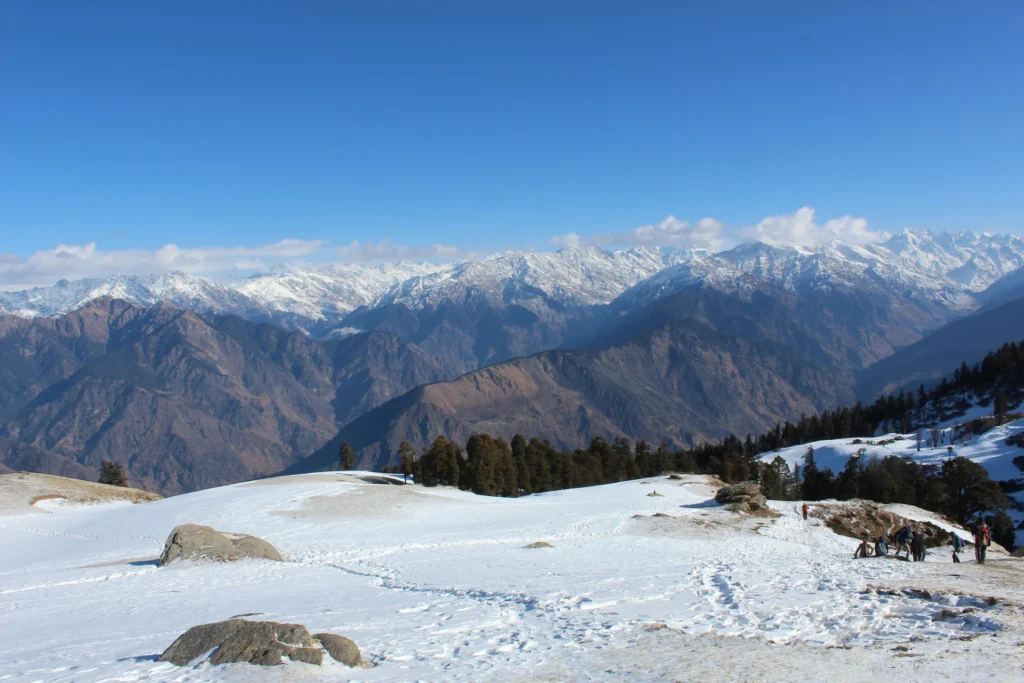
The second day starts early in the morning from Pipalkoti. You will have the yummiest breakfast and tea. Make sure you get ready on time, as mentioned by your trek leaders. After breakfast, the team leaves for Govindghat, which is around 52 km away. During the drive, you will also cross one more prayag of Uttarakhand, Vishnuprayag, where the Alaknanda River meets the Dhauliganga River. The mountain views become even more beautiful from here, and your journey continues.
After reaching Govindghat, trekkers take a local vehicle till Pulna. It only takes around 15 minutes, and this short drive is already included in the trek package. Pulna is the point from where the actual trek begins. From here, you will start a around 9 km uphill trek towards Ghangaria along the Pushpawati River. The sound of the river keeps following throughout the trail and at one point, you will see the river in its full view.
The trail is properly made with stone-paved paths and some stairs in between, so it is easy to follow. Since this route is also used by pilgrims going to Hemkund Sahib, the trail remains crowded and lively most of the time. You will also find many small shops and tea stalls on the way selling tea, cold drinks, Maggi, parathas, omelettes, and snacks, so there is no need to worry about food during the trek. We also recommend keeping some healthy, protein rich snacks, dry fruits, and protein bars. They are good for munching and also work as instant energy providers. After walking for around 4 km, you will reach Bhyundar village. This place offers beautiful views of Hathi Parvat, and many trekkers stop here for a short rest. After this point, the climb starts becoming steeper, and by evening, you will finally reach Ghangaria at an altitude of around 9,800 ft
Ghangaria to Valley of Flower and back to Ghangaria
- Altitude :
- Ghangharia : 3,000 m / 9,800 ft.
- Valley of Flowers : 3,500 m / 11,500 ft.
- Altitude Gain : 500 m / 1,700 ft.
- Trek Distance : 4 km each way | 7 hrs.
- Accommodation : Guest House
Today is the absolute dream day you have been waiting for! Wake up early with a heart full of excitement and enjoy a hot breakfast at the guest house. You will collect your packed lunches from the WTM kitchen team because there are absolutely no shops or food stalls inside the Valley of Flowers National Park.
You will first head towards the forest checkpoint just outside Ghangaria village. Once the permits are checked, you will step onto the trail leading into the UNESCO World Heritage Site. The path here is completely mule-free. The initial trail is covered with so many beautiful trees and their colorful leaves. Then you pass across a beautiful footbridge over the roaring Pushpavati River. This point of the trek is one of the best attractions. Seeing the river flowing between the big heavy stones looks thrilling.
Through the steep half of the climb, you will find valleys and waterfalls. This waterfall is also a point from where you can fill up your water bottles. And then the landscape will open up into a meadow that you have been looking forward to. You will find yourself standing right in the middle of the legendary Valley of Flowers! Endless fields of pink, yellow, blue, and white flowers stretch as far as your eyes can see, looking like a floral dream. You can spend hours slow-walking on the flat trails, spotting legendary flowers like the Himalayan Blue Poppy and the Brahma Kamal.
Ghangaria to Hemkund Sahib and back to Ghangaria
- Altitude :
- Ghangharia : 3,000 m / 9,800 ft.
- Hemkund Sahib : 4,300 m / 14,100 ft.
- Altitude Gain : 1,300 m / 4,300 ft.
- Trek Distance : 6 km each way | 8–9 hrs.
- Accommodation : Guest House
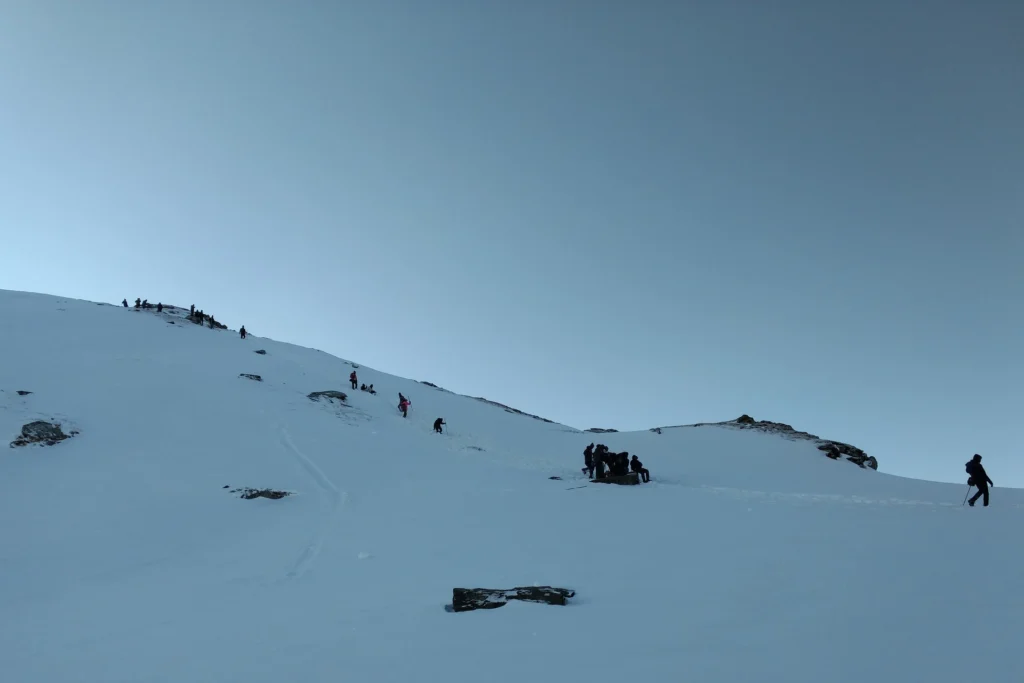
Today’s trek is a steep 6 km uphill climb. You will immediately notice the sharp incline. Unlike yesterday’s less crowded forest trail, today’s route is filled with the pilgrims. The higher you climb, the more beautiful the views become. There are no treelines on this trail; the path is mostly stone-paved, with sections of stairs and a few rough patches along the way. From the higher points, you will see valleys and clouds drifting across the sky. At one point you will find the big rocky mountains, and on the opposite side of it, you will keep seeing the green mountains. You will be standing somewhere on the paved trail, admiring all of these views!
Since it is a steep continuous climb, you are advised to take slow, steady steps and keep sipping water to adjust to the high altitude. After a strenuous few hours of climbing, you will finally reach the top, standing at a grand altitude of 14,400 feet. Right in front of you will be the Hemkund Sahib, the highest Sikh Gurudwara in the world, radiating an unbelievable serenity.
Next to the holy shrine lies the crystal-clear glacial lake. The lake looks extremely beautiful, all surrounded by seven snow-covered mountain peaks. If the weather is clear, you will see the reflection of the mountains mirrored in the frozen or icy waters. You can sit by the lake, soak in the spiritual aura, and listen to the beautiful kirtan echoes coming from the Gurudwara. The weather at this extreme altitude can change very quickly and the temperatures drop rapidly, so you are advised not to stay at the top for too long. By early afternoon, you will begin your 6 km descent back down the same path toward Ghangaria.
Ghangaria to Govindghat and Drive to Pipalkoti (Badrinath optional)
- Altitude :
- Ghangharia : 3,000 m / 9,800 ft.
- Govindghat : 1,828 m / 6,000 ft.
- Pipalkoti : 1,340 m / 4,400 ft.
- Badrinath : 3,133 m / 10,279 ft.
- Altitude Gain (Govindghat–Badrinath) : 1,305 m / 4,279 ft.
- Altitude Loss (Ghangharia–Pipalkoti) : 1,660 m / 5,400 ft.
- Trek Distance (Ghangharia–Pulna) : 9 km | 4–5 hrs.
- Drive Distance (Pulna–Govindghat) : 4 km | 15 min.
- Drive Distance (Govindghat–Badrinath) : 25 km | 1 hr.
- Drive Distance (Badrinath–Pipalkoti) : 75 km | 3–4 hrs.
- Accommodation : Guest House
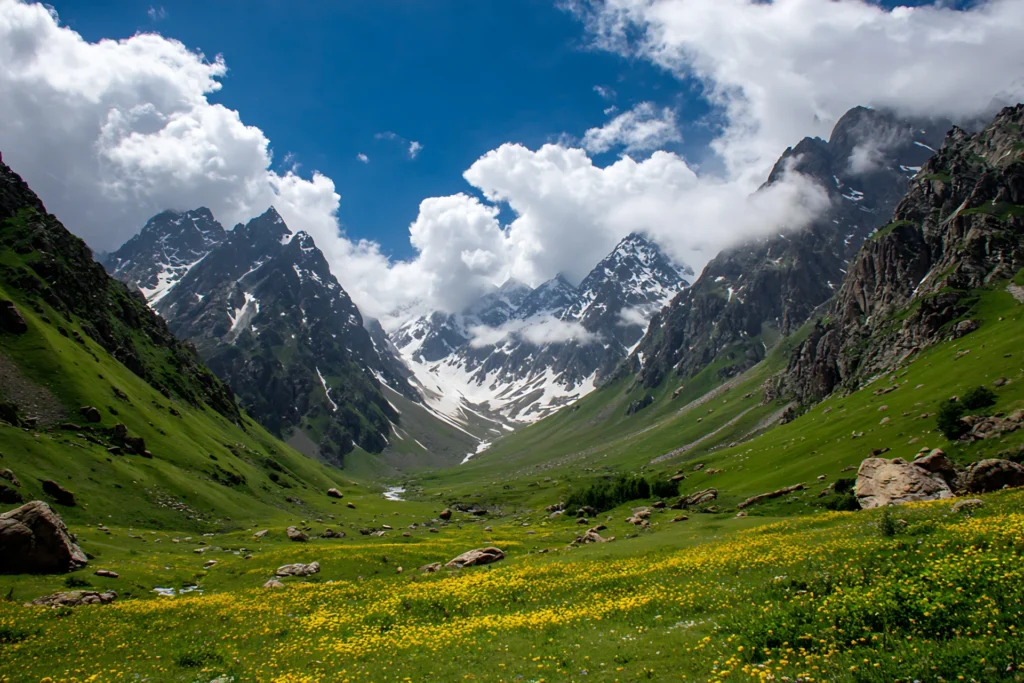
You will start your journey back after visiting the Valley of Flowers and Hemkund Sahib. You will trek from Ghangaria to Pulna and then drive to Govindghat, from where you will continue your drive to Pipalkoti. There is also an optional visit to the Badrinath Temple on this day.
The 9 km trek feels lighter today, and you can really enjoy the surroundings without any tiredness. You pass through small tea stalls, and resting spots where you probably stopped earlier. The atmosphere is happy, and a little emotional as the trek comes to an end. By midday, you will reach Pulna village, where the trekking part officially ends.
Optional Visit to Badrinath Temple
Once you reach Govindghat, you have a wonderful optional plan for the day! If the weather is good, the roads are clear, we can take a drive to the Badrinath Temple, which is about 25 km away from Govindghat. Dedicated to Lord Vishnu, Badrinath is one of the most sacred Char Dham pilgrimage sites in India. You will also witness the grand peaks around the temple with the stunning Neelkanth peak rising in the background. Visiting this ancient temple and witnessing its divine atmosphere adds a wonderful spiritual touch to the end of your adventure.
(Please note: Visiting Badrinath depends entirely on local road conditions, traffic, and time availability).
Pipalkoti to Rishikesh
- Altitude :
- Pipalkoti : 1,340 m / 4,400 ft.
- Rishikesh : 372 m / 1,220 ft.
- Altitude Loss : 968 m / 3,180 ft.
- Drive Distance : 200 km | 9–10 hrs.
The last day of the journey starts from Pipalkoti after breakfast. Today you begin your drive back to Rishikesh, covering a distance of around 200 km. It is a long drive of about 9-10 hours. Moving down from the mountains, you once again pass through the beautiful valleys and rivers of Uttarakhand. The same routes now feel different because you are no longer rushing towards the trek, but heading back with a bag full of memories. You cross familiar towns and river confluences on the way, and the Alaknanda River keeps you company for most of the journey.
There are stops for tea and short breaks, where trekkers usually talk about their experience. The Valley of Flowers, Ghangaria, Hemkund Sahib, and the entire trail feel fresh in memory, and everyone shares their favorite moments from the trek. By evening, you finally reach Rishikesh, where the journey ends.
Health Awareness
- Pulse rate at rest must be in between (60 to 100 beats per minute).
- Blood Pressure Reading must be in between (DIASTOLIC 75 – 85, SYSTOLIC 100 - 130 mm Hg).
- Respiratory rate at rest must be in between (12 to 20 breaths per minute).
- Should not have Liver and kidney issues.
- Should not have Diabetes Mellitus, Bronchial Asthma, Heart problems, Hypertension, etc.
- No pacemaker implant.
- People with Sinus issues, Epilepsy please contact to trek coordinator before booking the trek.
- If your BMI is not normal, Please contact our Trek coordinator before Trek booking.
Important Links
How to Reach:
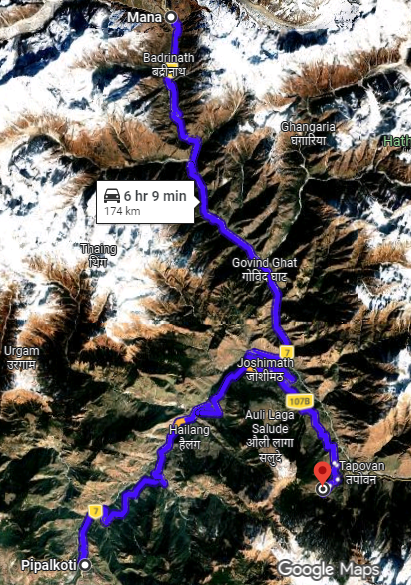
How to Reach Rishikesh?
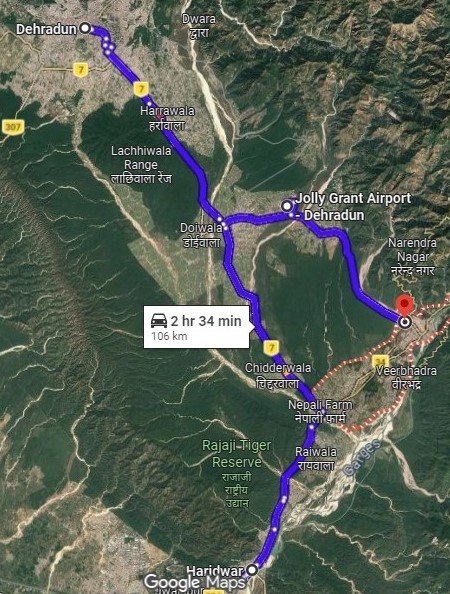
- Rishikesh is the main pickup point for the Valley of Flowers Trek by WTM, from where the journey of this trek begins. There are many ways to reach Rishikesh, but the most convenient option is to first arrive at the Dehradun/Delhi bus station, airport, or railway station, depending on your preference. From there, you can take a bus, train, or book a cab to Rishikesh.
- Please Note : The most ideal and closest transport to reach Rishikesh is from Haridwar or Dehradun.
Arrival by Bus:
If you are taking a bus to Rishikesh, it is highly convenient to catch one from either Dehradun or Delhi.
- From Dehradun : First reach the Inter-State Bus Terminus (ISBT) Dehradun. From there, you can take a direct local or state transport bus to Rishikesh, which will take approximately 1.5 to 2 hours to reach.
- From Delhi : Reach the ISBT Kashmiri Gate in Delhi and take a direct bus to Rishikesh, which takes around 6 to 7 hours to reach.
- (We highly recommend choosing government Uttarakhand Transport Corporation (UTC) buses over private ones, as they are generally more reliable, while private buses can sometimes be prone to delays. Whichever option you choose, ensure you reach Rishikesh by 6:00 AM on the pickup day).
Arrival by Air:
For international and domestic trekkers opting for a flight, the most preferred option is to fly into Jolly Grant Airport (Dehradun Airport), which is exceptionally close to Rishikesh.
Location | Travel Guide |
Delhi | The Indira Gandhi International Airport, Delhi, is the prime airport that offers multiple daily direct flights to Jolly Grant Airport (Dehradun). Major airlines operating this route include IndiGo, Alliance Air, and Air India. |
Outstation | You can book a direct or connecting flight to Dehradun Airport. If direct flights are unavailable, flying via Delhi is the best route. |
From Dehradun Airport to Rishikesh:
The distance between Jolly Grant Airport and Rishikesh is around 22 km. After arriving at the airport, you can easily take a public bus, or book a private cab to reach the WTM pickup point.
Note: If you are arriving by air, it is recommended to reach one day in advance.
Arrival by Train:
Rishikesh is well connected by rail via the Yog Nagari Rishikesh Railway Station (YNRK). Alternatively, the Haridwar Railway Station (HW) is located around 28 km away and serves as a major national rail junction.
- Via Yog Nagari Rishikesh : If your train terminates here, you can take a short auto-rickshaw or cab ride directly to the assembly point.
- Via Haridwar : From Haridwar Railway Station, you can take a direct local bus or a shared auto-rickshaw to Rishikesh ISBT/pickup point, which takes about 1 hour. To know more about the train schedules, you can visit the IRCTC website.
How to reach Pipalkoti
If you have not opted for the WTM transport package, you will need to reach the initial base locations on your own.
The best options are to take a government UTC bus heading towards Joshimath from the Rishikesh bus stand early in the morning (departures usually peak between 5:00 AM and 8:00 AM), or book a private cab.
If you have not opted for the WTM transport package, you will need to reach the initial base locations on your own.
Pick Up Information
- Trekkers who wish to opt for the pickup and drop-off service can select this option during the booking process under the "View Add-ons" section.
- Trekkers need to assemble at Back Stayz Hotel, Laxman Jhula, near SBI Bank, Tapovan, Rishikesh, at 6:00 AM for their Valley of Flowers Trek by Walking The Mountains.
- If you have opted for WTM’s pickup and drop-off service, your travel from the Rishikesh assembly point to the mountain base camps will be completely managed by WTM.
Drop-Off Information:
- The designated drop-off point at the end of the trek is the Back Stayz Hotel, Laxman Jhula, near SBI Bank, Tapovan, Rishikesh.
- The drop-off is scheduled on Day 6 between 6:30 PM to 7:30 PM. We firmly advise all trekkers to plan their onward travel arrangements (trains or flights) after 8:00 PM.
- We strongly recommend keeping a buffer day in your travel plan. Mountain roads are prone to monsoon landslides and delays. If everything goes as planned, you can use that buffer day to explore Rishikesh.
- As part of our transport service, WTM offers comfortable transportation modes such as Tempo Travelers, Boleros, or equivalent vehicles.
- If you wish to upgrade your private mode of transportation, you can reach out to your designated trek coordinator for further assistance.
Cost Terms
1. Accommodation (as per the itinerary)
- Guest house in Pipalkoti(Day 1 and Day 5 as per the itinerary).
- Ghangharia on Day 2, Day 3, and Day 4.
- Triple/quad sharing (separate for males and females throughout the trek)
2. Meals (Veg + Egg)
- All meals (including tea, soup, snacks, etc.) from Day 1 Dinner to Day 5 Dinner. Morning and evening tea, accompanied by light snacks, are included in the Valley of Flowers trekking package.
3. Support
- 1 Versatile base camp manager handles communication and deploys extra manpower in emergencies.
- 1 Mountaineering & First aid qualified professional trek Leader.
- 1 Experienced high-altitude chef.
- Local experienced guides (Number of guides depending on the group size).
- Enough support staff.
4. Trek Equipment
- Sleeping bag, Sleeping liners (if required), mattresses, and Utensils.
- 3 men all season trekker tent (twin sharing), Kitchen & Dining tent, Toilet tent.
- Camping stool, Walkie talkie.
- Ropes, Helmet, Ice axe, Harness, Gaiters & crampons (if required).
5. First Aid
- Medical kit,Stretcher,Oxygen cylinder,Blood pressure monitor,Oximeter,Stethoscope.
6. Transportation (as per the itinerary)
- Transport from Rishikesh to Pipalkoti and return (If opted from WTM).
- Transport Pipalkoti to Govindghat, Pulna & Badrinath and return as per the itinerary ( If opted from WTM).
7. Mules/porters to carry the central luggage.
8. Cloakroom facility available at the base camp for additional luggage
9. All necessary permits and entry fees, Upto the amount charged for Indian
10. Trek Completion Certificate.
- Insurance (For non-Indian Nationals, NRI or OCI card holders).
- Food during the transit.
- Any kind of personal expenses.
- Mule or porter to carry personal luggage.
- Emergency evacuation, hospitalization charge, etc.
- Any extra costs incurred due to extension/change of the itinerary due to natural calamities roadblocks, vehicle breakdown, etc. factors beyond our control
- Anything not specifically mentioned under the head Inclusion.
Trek Essentials
| Backpack with rain cover | (40 – 50 ltr) with comfortable shoulder straps |
| Day pack with rain cover | 20 – 30 ltr (If off-load opted) |
| Walking stick | Advisable (At least one) |
| Water Bottle / Hydration pack | 2 bottles of one liter each, People who use hydration pack 1 hydration pack and 1 bottle of one liter, Carry at least one thermos flask. |
| Small size tiffin/lunch box | 1 Nos |
| Snacks | Energy bars, dry fruits, electral/ors |
| Personal Medical Kit | Consult your doctor |
| T-Shirt (Synthetic quick dry) | 1 Full & 1 Half sleeves |
| Fleece T-shirt | 1 Nos |
| Fleece jacket | Not required |
| Windproof Jacket | 1 Nos |
| Down feather / Hollow jacket | 1 Nos |
| Thermal inner (Upper and Lower) | 1 Pair |
| Trek Pant (Synthetic quick dry) | 1 Nos |
| Fleece Pant | Not required |
| Waterproof gloves | Not required |
| Fleece / woollen gloves | 1 Pair |
| Poncho / waterproof Jacket and pant | 1 Nos |
| Head torch | 1 Nos. (Avoid Hand torch) |
| Sun cap | 1 Nos. (One that covers the neck as well) |
| Woolen cap | 1 Nos. |
| Balaclava | Not required |
| Buff / Neck-gaiters | 1 Nos. |
| Sunglasses | UV with dark side cover, People who wear spectacles – (A)- Use contact lenses | (B)- Photo chromatic glasses |
| Trekking shoes | 1 Pair (Water-resistant, high ankle with good grip) |
| Floaters / flip-flops | 1 Pair |
| Cotton socks | 6 pairs |
| Woollen socks | 1 pairs |
| Gaiters | 1 Pair (WTM provides when required) |
| Micro spikes | 1 Pair (WTM provides when required) |
| Sunscreen cream | 1 Nos |
| Moisturiser | 1 Nos |
| Chap-stick / Lip balm | 1 Nos |
| Toothbrush and toothpaste | 1 Nos |
| Toilet paper & Wipes | 1 Nos |
| Soap / hand sanitizers | 1 Nos |
| Antibacterial powder | 1 Nos |
| Quick dry towel | 1 Nos |
Gallery
Cancellation Terms
To request a cancellation, please email us at info@walkingthemountains.com using your registered email ID.
Cancellations prior to 28 days from the start of the Trip
Refund Options
- 5% deduction of trek fee
- 100% trek fee cash voucher for any trip until six months from the date of last trek.
- Transfer your trek (any trek, any date) to your friend
Cancellation between 27 days and 15 days to the start of the Trip
Refund Options
- 30% deduction of trek fee
- 100% trek fee cash voucher for same trip till one year
- 85% trek fee cash voucher for any trip till one year
Cancellation between 14 days and 8 days to the start of the Trip
Refund Options
- 50% deduction of trek fee
- 80% trek fee cash voucher for same trip till six months.
- Book the same trek, in the same season, with any other batch
- Transfer your trek (same trek, any date) to your friend
Cancellation less than 7 days to the start of the trek.
Refund Options
- No cash refund
- 20% trek fee cash voucher for the same trip until six months.
Itinerary and Modifications
- WTM reserves the right to modify, shorten, or cancel any part of the Trip due to transportation delays, weather, health emergencies, or other unforeseen circumstances including Force Majeure.
Cancellations and Refunds
- No refunds or vouchers, partial or otherwise, shall be provided for voluntary withdrawal, non-utilisation of services, or removal from the Trip.
- If WTM cancels the Trip before arrival at the designated pick-up point due to unforeseen circumstances or Force Majeure, the Participant may choose from:
- An alternate Trip/date.
- A credit voucher valid for one (1) year.
- Transfer to another Trip, with cost differences payable by the Participant.
- If the Trip is abandoned post-arrival at the designated pick-up point, no cash refund or voucher shall be issued. The Trek Again Policy may apply at WTM’s discretion.
- WTM shall not be liable for any associated travel costs such as flights, accommodation, or visa fees.
Force Majeure
- Events beyond its control including but not limited to earthquakes, landslides, strikes, curfews, war, pandemic, government restrictions, heavy rainfall or snowfall, windstorms, road blockages, trail disruption, or withdrawal of permits, WTM shall not be held liable for any cancellation, delay, or service modification caused by Force Majeure.
FAQ’S
The best time to visit the Valley of Flowers is between June and September, right after the snow has melted and the valley comes alive. July and August are peak bloom months when thousands of flowers are in full color. The monsoon rains bring the valley to life, and makes it the most colourful and vibrant during this time.
The Valley of Flowers is situated at an altitude of around 12,000 ft, while Hemkund Sahib is located at a higher altitude of about 14,100 ft.
During the Valley of Flowers trek, you can expect to stay in simple lodges or guest houses along the way. These places offer basic but comfortable rooms with the necessary things like beds, blankets, and clean washrooms. Camping is not allowed inside the valley itself, so all stays are in nearby villages like Ghangaria. While the facilities are not very fancy, they are good enough to rest and relax after a long day of trekking.
No, camping is not allowed during the Trek, as it is protected UNESCO World heritage Site. Trekkers usually stay at Ghangaria, which is the base camp for both the Valley of Flowers and Hemkund Sahib trek.
Yes, the Valley of Flowers is a safe place to visit. The local people are kind, helpful, and welcoming towards tourists. However, like any mountain journey, it's always a good idea to check the weather forecast and road conditions before you start your trip, especially during the rainy season. If you're trekking with us, your safety is our top priority.
Yes, Hemkund Sahib is included in the Valley of Flowers trek itinerary. On Day 4, trekkers visit Hemkund Sahib from Ghangaria and return the same day. The trek to Hemkund Sahib is steeper and more challenging compared to the Valley of Flowers trail, but the beautiful views and spiritual atmosphere make it a very special experience.
Yes, children (minimum 9 years old) and fit older people can complete this trek. The trail is well-paved, but it is steep at some sections and requires good stamina to walk. For anyone who cannot walk long distances, local helpers offer porters to carry you or your bags from the starting point up to the Ghangaria base camp. (However, please note that ponies are banned inside the actual flower valley, so trekkers and visitors must be able to walk the final flat stretch).
Valley of Flowers trek is beginner-friendly, it still requires a reasonable level of fitness, as the trail includes long walking hours and altitude gain. Preparing in advance will help you enjoy the trek without unnecessary exhaustion or risk.
Here’s a simple fitness benchmark you should aim to meet before starting the trek:
- You should be able to jog 5 kilometers in 35 minutes without feeling overly tired.
OR
- If you prefer cycling, you should be able to cover 10 kilometers in 30 minutes comfortably.
No, staying overnight at Hemkund Sahib is not allowed. The place is located at a high altitude and weather conditions can turn extreme quickly, especially after sunset. Pilgrims and trekkers are allowed to visit during the day, but everyone must return to Ghangaria, the base village, by evening.
Yes, there is an entry fee to visit the Valley of Flowers National Park. But if you are trekking with Walking The Mountains, you don’t have to worry, we take care of getting the entry permit for you.
Yes, beginners can definitely do the Valley of Flowers trek. With basic fitness and the right preparation, it’s a great choice for first-time trekkers. The well-laid path and support from guides make it beginner-friendly.
During the Flower Valley trek, you’ll get to see over 500 different types of flowers blooming across the meadows. The valley turns into a colorful carpet of blossoms, especially during the monsoon season when most of the flowers are in full bloom. Many of these flowers are not just beautiful but also have medicinal properties. You’ll also come across some rare and endangered species that are hard to find elsewhere, like the Brahmakamal, Blue Poppy, and Cobra Lily.
Mules are available from Govindghat to Ghangaria for carrying luggage. They are also available for the Hemkund Sahib trek. However, mules are not allowed inside the Valley of Flowers, so trekkers have to explore the valley on foot.